
 Leong Wen Xyuan
Join LEONG WEN XYUAN as she explores how social mixers and third spaces are giving youths a platform to meet, connect, and grow outside the screen.
Many youths today find themselves navigating both career ambitions and social lives in digital-first environments. As daily routines become more screen-driven and time feels increasingly fragmented, both offline and online third spaces are gaining value as places to form meaningful connections beyond home and work. These spaces offer balance for youths to engage more intentionally with others.
First, Second, Third: Finding Your Space
The concept of a ‘third space’ traditionally refers to a setting outside of home, school, and work where people can gather, converse, and build connections. For youths in Singapore, these spaces have become more appealing as a pushback against the fact that everyday interactions increasingly take place through screens.
Meet Tham Jun Han, 32, co-founder of the social enterprise Friendzone SG. Inspired by his time living on campus in university, Mr Tham recalls experiencing a strong sense of community spirit also known as kampung spirit that stood in stark contrast to life after graduation. “Friendzone was an exploration of what it will take to rebuild this kind of kampung spirit in our neighbourhoods,” he says, reflecting on the sense of togetherness he hopes to recreate.
While Friendzone primarily hosts short-term events, Mr Tham shares a longer-term vision for creating a more permanent third space. “A third space is more of a permanent space where people come and go, hang out, [and] have conversations, and that is something that Friendzone aspires to do this year,” he explains.
In April 2026, Friendzone plans to pilot a conversation card library, where participants can borrow cards and engage in guided conversations with friends, family, or partners.
Tables, Cards, and Deep Conversations
Unlike traditional networking events, which can often feel intimidating or superficial, Friendzone designs its gatherings to encourage more intentional and personal conversations. “All of our events are very conversation-driven,” Mr Tham says, “We have very intentionally designed conversations at tables with a facilitator…we feel that [this approach] appeals to a larger audience.”
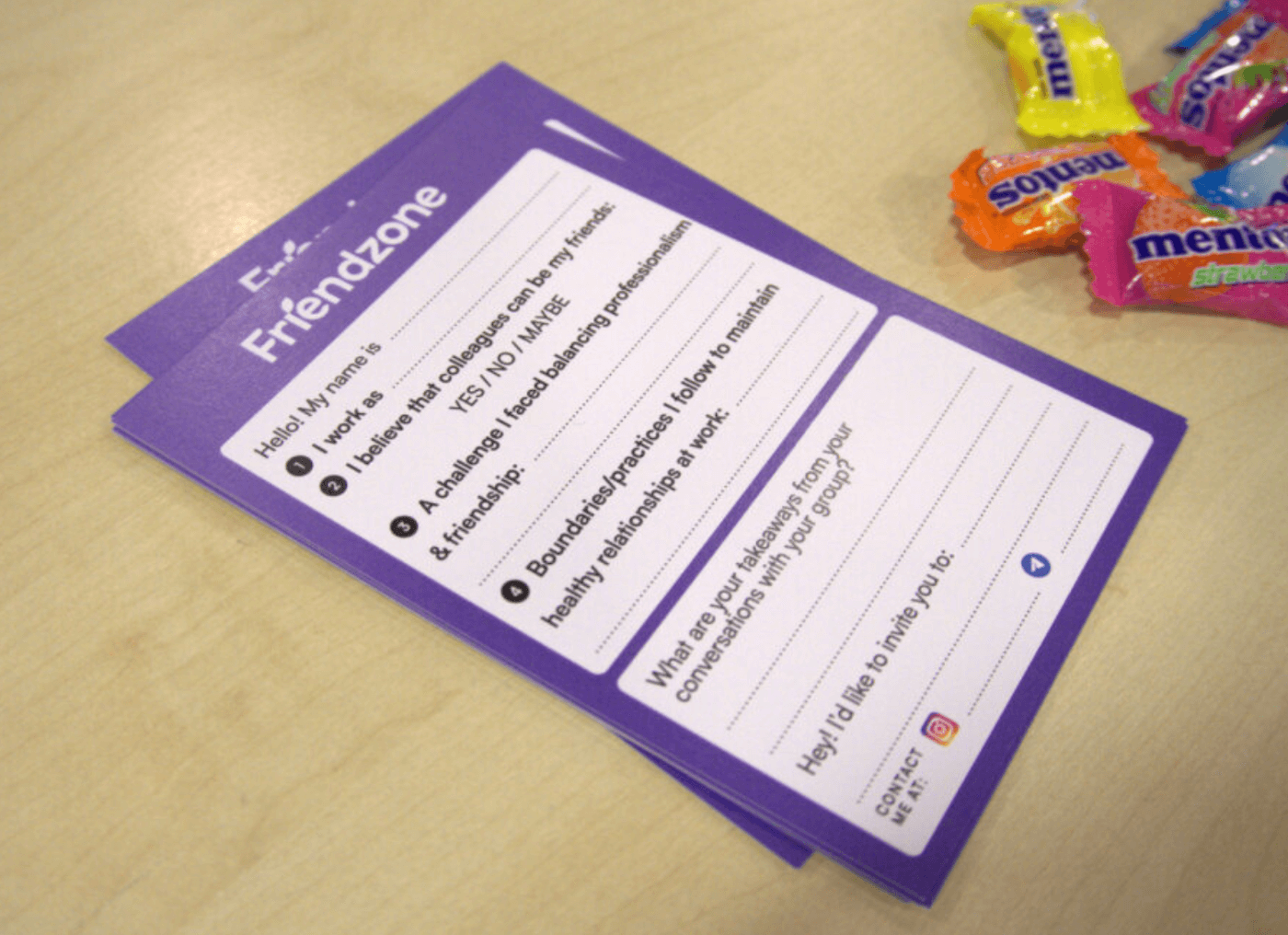
We attended and spoke to participants at a Friendzone event curated to navigate workplace friendships in the media, design, and marketing sector. Many shared that these small, guided discussions help create more meaningful and genuine engagement.
Jaidyn, 25, a first-time attendee, recalls that there was sufficient time to connect with others. While the conversations felt awkward at first, she shareds that, “when people’s walls start to come down a little bit, [they] start to realise that we’re talking about real life experiences…that’s when everything feels a little more cordial, and everyone feels comfortable to share.”
Even when participants acknowledge that maintaining connections after a single event requires extra effort, the initial experience often leaves a lasting impression. Jia Yu, a 25-year-old first-time attendee, shareds, “If the opportunity rises, I definitely would like to meet together more often. But as of now, it would just be keeping in touch through [social media],”
More Than Mingling
Third spaces and social mixers do more than create social circles, they also cultivate soft skills and personal growth. Mr Tham notes that Friendzone also hosts “Friendship School”, a series of workshops that focus on communication, navigating relationships, and improving interpersonal skills. “Singaporean youths especially, feel quite shy to step out of their comfort zone and meet someone new…if everyone is feeling shy, we need to create an intentional platform for people to meet,” he remarks.
These spaces provide youths with practical support as they navigate transitioning into the early stages of adulthood. Participants like Aiko, 20, and Lily, 22, highlight how the shared experiences of peers can create a sense of relatability and belonging. “[It’s] a nice opportunity to connect with other creatives,” Aiko says.
Participants often leave social mixers with a sense of reassurance, realising that their struggles and uncertainties are shared by others navigating similar paths, which helps normalise their experiences and reduce feelings of isolation.
Three’s a Crowd?
Despite the common assumption that social mixers feel commercial or forced, Friendzone challenges this narrative by prioritising smaller, more intimate group settings over large-scale mingling. “No matter how large the event is, a big portion of [it] is spent in a small group of five…[to] retain the intimacy of having a good conversation with new people,” Mr Tham says. In these settings, depth is valued over numbers.
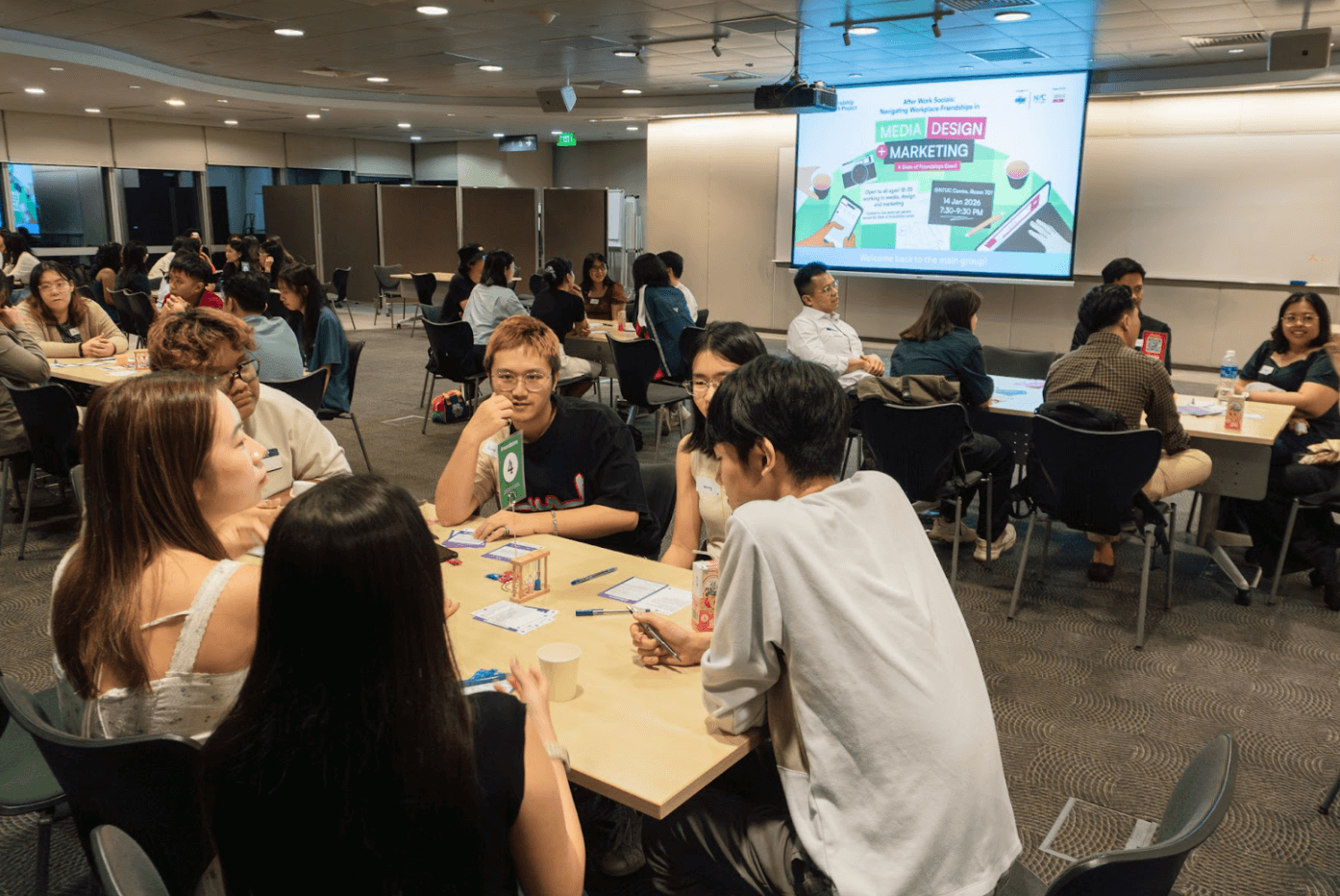
This structure eases the pressure often associated with networking. Instead of having to constantly introduce oneself to strangers, a small group allows conversations to flow naturally.
For participants like Jia Yu, the guided prompts encouraged reflection and vulnerability. “We had to put in quite a lot of thought to answer the questions. It wasn’t something very surface level or something that could be answered very easily,” she shares, noting that social spaces are not about performing socially, but simply listening, sharing, and responding.
Balancing Structure and Authenticity
While digital platforms make staying connected easier, they cannot fully replace the depth of face-to-face interaction. Social mixers and emerging third spaces create intentional environments where youths converse in the moment, beyond surface level exchanges online.
These spaces offer more than opportunities to meet new people. They foster a sense of belonging, shared understanding, and mutual support, whether through emotional connection or practical advice. For youths, they provide low-stakes, supportive environments to explore relationships and personal growth. In an increasingly fast-paced, digital society, their growing appeal reflects a continued need for genuine human connection.
Watch the full video here: https://youtu.be/1UwncfNbOso